You don't have to wait until something frightening happens to learn how to defend yourself.
And you certainly don't have to become a different person first.
I'm Victoria Gracie. Before I became a self-defense instructor, I spent more than fifteen years working as a professional dancer, actress, and performer. I knew how to move my body. I knew how to follow choreography under pressure. What I hadn't learned was how to use those abilities to protect myself.
Jiu-jitsu changed that.
Today, I teach women who want to feel more capable in their own bodies. Some are excited to begin. Others aren't sure they belong on a martial arts mat.
Both are welcome.
If you've been searching for Gracie Women Empowered, here's what I want you to know about the lessons, the training experience, the pink belt, and how to get started.
What Is Gracie Women Empowered?
Women Empowered is a beginner-friendly self-defense program created by Gracie University. It teaches women how to respond to common physical threats using principles from Brazilian Jiu-Jitsu.
According to the official Women Empowered program, the in-person curriculum consists of 15 one-hour classes built around 20 essential self-defense techniques.
The program also teaches awareness, verbal boundaries, and ways to assess potentially dangerous situations.
The goal is to develop practical skills through repeated, guided training.
A Self-Defense Program Built Around Gracie Jiu-Jitsu
One of the reasons I fell in love with jiu-jitsu was how familiar the movement felt to me as a dancer.
Timing matters. Balance matters. Understanding where your weight is matters.
But jiu-jitsu gave those movements a different purpose.
Instead of learning choreography for an audience, I was learning how to handle physical resistance.
Women Empowered uses leverage, positioning, and timing to help students respond to someone who may be larger or stronger. That doesn't mean physical size stops mattering. It means strength isn't the only tool you can learn to use.
Who Created Women Empowered?
Women Empowered is part of Gracie University, with Eve Torres Gracie and Rener Gracie serving as the lead instructors of its online Pink Belt Qualification Course.
I teach Women Empowered at Gracie University headquarters in Torrance, California.
For me, the work goes beyond teaching a sequence of movements. It's about helping women recognize that their safety, their boundaries, and their ability to respond matter.
Is Women Empowered Right for Complete Beginners?
Yes. You can begin without knowing anything about jiu-jitsu.
Gracie University welcomes students with no previous experience, and the curriculum is designed so you can enter the regular class rotation at any point.
You don't need to understand martial arts terminology before attending.
You don't need to have competed in sports.
And you don't need to arrive feeling brave.
Do You Need Strength or Athletic Experience?
No previous athletic training is required.
You will still use your body, practice movement, and gradually learn how to respond to physical pressure. Some movements may feel unfamiliar at first.
That's part of learning.
When I first discovered jiu-jitsu, I already had years of movement training behind me. Even then, I had something new to learn.
Being good at one physical skill doesn't mean you automatically know another.
Give yourself permission to be a beginner.
What If You Feel Nervous About Starting?
You can be nervous and still show up.
Maybe you're uncomfortable with close physical contact. Maybe you're worried about doing something wrong. Maybe you're simply walking into a room where everyone else seems to know what they're doing.
Tell your instructor.
Ask questions. Take your time. Speak up about your comfort and physical limitations.
You are there to learn, not to prove something to the room.
What Will You Actually Learn in the Women Empowered Program?
The curriculum addresses 20 essential self-defense techniques, including responses to grabs, chokes, being pinned, and other forms of physical control.
These aren't random moves collected into a workout. They are organized around situations a person may need to recognize and respond to.
Defending Against Grabs, Holds, and Chokes
Imagine someone grabbing your wrist as you're trying to leave.
Or holding your hair.
Or putting their hands around your neck.
Women Empowered includes wrist releases, hair grab defenses, and front choke defenses.
Students practice how body position, leverage, and movement may create an opportunity to break free.
The purpose isn't to memorize a dramatic move. It's to understand what to do when someone tries to control your movement.
Escaping When You Are Pinned to the Ground
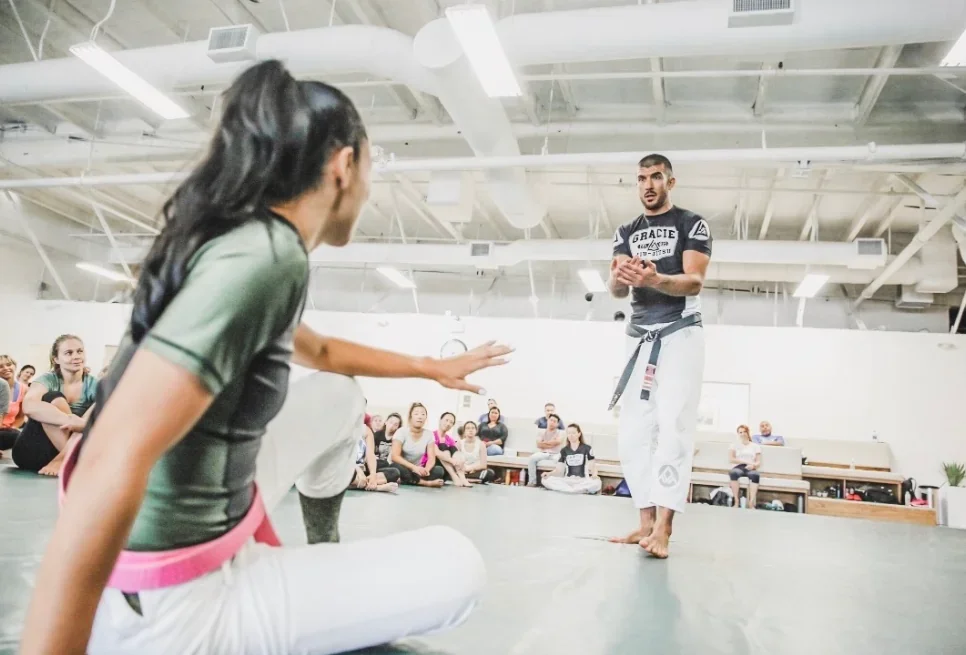
This is one of the areas where jiu-jitsu offers a different way to think about self-defense.
Many people imagine protecting themselves while standing. But what happens if you fall or someone holds you down?
The curriculum includes techniques such as trap and roll escapes, guard get-ups, and the Elbow Escape.
Students learn ways to manage position, make space, and work toward getting up or escaping.
These movements take practice, particularly when someone is applying resistance.
Understanding Weapon Threats and Dangerous Situations
The online curriculum also includes a lesson on weapon defenses.
These are serious situations with unpredictable outcomes.
No technique can guarantee your safety, especially when a weapon is involved. Physical resistance may increase danger in some circumstances.
Learning about these situations should include understanding risk, possible options, and the limits of physical techniques.
Awareness, Verbal Boundaries, and Recognizing Risk
Some of the most meaningful self-defense skills aren't physical.
Women Empowered also introduces awareness and verbal strategies, including recognizing concerning behavior and communicating boundaries.
I believe this work matters outside the classroom, too.
You can practice saying no. You can notice when something feels uncomfortable. You can learn to trust yourself enough to leave a situation.
And I want to be clear about something: if someone chooses to hurt you, that responsibility belongs to the person causing harm. It does not belong to you because you didn't recognize a warning sign or remember a technique.
How Do the 15 Women Empowered Classes Work?
The in-person program has a rotating curriculum of 15 classes. Each class is approximately one hour and covers two techniques.
You can begin with whichever class is scheduled when you join.
One-Hour Classes You Can Take in Any Order
You don't have to wait for Class 1.
Perhaps your first session covers a wrist release. Another day, you may practice a ground escape.
As you continue attending, you'll work through the full curriculum.
The official class structure lets you learn at your own pace, rather than requiring every new student to start on the same date.
How Your Progress Is Tracked
Students at participating certified training centers receive an attendance card to record completed lessons.
That card matters because Women Empowered is built around repetition.
The first time you learn something, you're figuring out where your hands and feet belong.
The next time, you may notice a detail you missed.
Eventually, movements can begin to feel more familiar.
Completing each class once is your first curriculum milestone. It isn't the same as qualifying for a Pink Belt.
What Should You Expect at Your First Women Empowered Class?
Your first class isn't a test of what you already know.
It's your introduction to a new way of moving and learning.
What to Wear and Bring
Start by contacting the training center to confirm its clothing requirements.
For an introductory session, ask whether you can wear comfortable athletic clothing or whether a uniform is required.
Choose something that allows you to move without constant adjustment. Bring water and let the instructor know about any injuries or movement restrictions.
You can also ask whether classes involve barefoot training, partner work, and any equipment you need.
What Practicing With a Partner Looks Like
Jiu-jitsu involves learning how your body moves in relation to another person.
That means you may practice with a partner while an instructor explains a technique and helps you work through it.
You might need several attempts to understand one movement.
That's normal.
If a technique hurts, something feels unsafe, or you're uncomfortable with a particular exercise, say so.
Your boundaries still matter when you're learning self-defense.
Can You Take the Gracie Women Empowered Program Online?
Yes. You can learn through Gracie University's online Women Empowered course.
But it's worth understanding that the online format and in-person class rotation are organized differently.
The Difference Between In-Person and Online Training
The in-person program has 15 one-hour classes covering 20 essential techniques.
The online Pink Belt Qualification Course contains 20 core video lessons and covers 63 techniques and variations.
Both are built around the Women Empowered approach to self-defense.
In-person training gives you direct instruction and practice with other students.
Online training gives you the option to study at home, review videos, and work through the lessons according to your schedule.
What Is Included in the Online Course?
Gracie University lists several learning resources with its online course:
20 core video lessons
Pink Belt testing videos and guidelines
A downloadable 90-page handbook
A progress tracking card
An 80-day training schedule
Access to an online student forum
FITjitsu, a bonus fitness program taught by Eve Torres Gracie and me
I co-created FITjitsu with Eve to bring together fitness and movements drawn from Women Empowered.
It's a different way to become familiar with how your body moves, but it doesn't replace the self-defense curriculum.
Do You Need Someone to Practice With at Home?
Yes. For meaningful physical practice and the Pink Belt testing path, you'll need a dedicated training partner.
Watching videos can help you understand a technique, but it can't fully recreate the experience of working with another person's movement and resistance.
Gracie University explains the home training and evaluation process, including submitting a recorded test for review.
Choose a responsible partner, prepare a suitable training space, and follow the course safety guidance.
What Are Women Empowered Reflex Development Classes?
Learning a technique and recognizing when to use it are two different things.
That's why the in-person curriculum includes Reflex Development, often called RD.
Moving From Learning Techniques to Practicing Responses
In a regular lesson, you can focus on a particular movement.
Reflex Development brings previously learned techniques together.
You practice choosing a response based on the position or situation instead of always knowing which technique comes next.
I love this part of learning because it asks you to connect what you've practiced.
Not perfectly. Just with growing understanding.
When Can You Begin Reflex Development?
According to Gracie University's progression requirements, you become eligible for RD classes after attending each of the 15 regular classes at least once.
You'll continue building your skills through further classes and practice.
RD is part of the in-person Pink Belt qualification path, not a replacement for the main lessons.
How Do You Earn Your Women-Empowered Pink Belt?
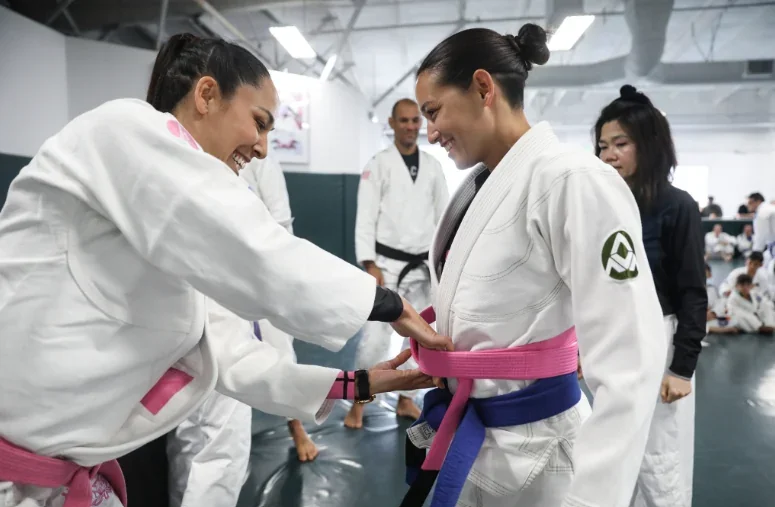
The Pink Belt recognizes successful completion of the program's technical evaluation.
It isn't awarded simply for signing up or attending a certain number of classes.
Step 1. Complete Your Classes and Build Consistency
For the published in-person qualification path, you must:
Complete each of the 15 regular lessons four times.
Attend at least eight Reflex Development classes.
Prepare to demonstrate the 20 essential techniques.
Those are the official Pink Belt eligibility requirements.
Think of this as practice over time, rather than a race to collect attendance marks.
Step 2. Prepare for the Pink Belt Test
The in-person qualification test lasts approximately 30 minutes and assesses your execution of the 20 techniques.
Students following the online course can use Gracie University's video evaluation process, recording their performance and submitting it for review by a certified instructor.
An evaluation fee applies each time you test, whether or not you pass.
Passing requires meeting the organization's stated technical standards.
Step 3. Earn Your Pink Belt and Understand What It Represents
The Pink Belt is specific to Women Empowered.
It is not a traditional Brazilian Jiu-Jitsu belt rank. Gracie University created it to recognize the separate curriculum, strategies, and self-defense knowledge taught in the program.
Successful candidates receive the official belt and promotion certificate without an additional belt or certificate charge.
And if you want to continue afterward, Gracie University identifies its Gracie Combatives program as one possible next step.
For me, the belt matters because of the practice behind it.
The work comes first. The recognition follows.
How Much Does Women Empowered Cost, and How Do You Sign Up?
There are different ways to join, and the cost depends on the training format you choose.
Understanding Online Course Pricing and Testing Fees
At the time of writing, Gracie University lists the complete online course at $249.
Subscription access is also offered, so review current options before purchasing.
Pink Belt testing carries a separate evaluation fee.
For in-person classes, contact the training center directly for current tuition, scheduling, and enrollment terms.
Finding a Certified Gracie Training Center Near You
If you'd prefer to train in person, start by checking the Gracie University school directory.
The official program page advertises a 10-day free trial at Certified Training Centers. Confirm availability and participation with your chosen location before visiting.
Ask when Women Empowered meets, what beginners should wear, and whether you need to book your first class.
If there isn't a convenient location, you can explore the online course instead.
Why I Teach Women Empowered: You Are Worth Defending
I spent years moving for an audience.
I learned choreography, worked on world tours, and built a career that required discipline and physical preparation.
But learning jiu-jitsu gave me something that performing never quite did.
I began to understand my body as something I lived in, not just something I used to perform.
Becoming a mother made that lesson even more personal.
I have two daughters. I think often about what they learn from watching me, especially when something is difficult or doesn't go according to plan.
I don't want them believing capability belongs only to naturally confident people.
I want them to know they can learn.
That's the same belief I bring to the mat.
Confidence Comes From Practicing, Not Being Perfect
One of the things I tell women is that they're worth defending.
That sentence is about more than a physical technique.
It asks you to recognize that your body belongs to you. Your limits matter. You can choose to learn skills that may help you respond when someone crosses those limits.
I don't believe confidence comes from getting everything right.
I believe it grows when you try, learn something, and discover that you can handle more than you thought.
That's what I hope you begin to experience through this program.
Not the promise that nothing bad will ever happen.
The knowledge that you have started preparing.
Ready to Take Your First Step?
You don't need to have your confidence figured out before you begin.
You can come curious. You can come nervous. You can come without knowing a single jiu-jitsu move.
Start by exploring the official Women Empowered program and choosing whether online or in-person training fits your life.
You can also visit my website to learn about my work, or contact me directly if you'd like to connect.
Your first step doesn't have to be perfect.
It just has to be yours.
Frequently Asked Questions About Women Empowered
1. Is empowerment only for women who have experienced an assault?
No. Women Empowered is designed for women who want to learn self-defense, whether or not they have experienced violence. The official program welcomes beginners and teaches both physical techniques and awareness skills.
2. Can I start Women Empowered if I am over 40 or not physically fit?
Yes. The program does not require previous athletic experience, and Gracie University describes it as suitable for women of different ages and fitness levels. You should still discuss injuries, health concerns, or movement restrictions with your instructor before participating.
3. What should I wear to my first Women Empowered class?
Ask your chosen training center about its dress requirements before your first visit. Comfortable athletic clothing may be appropriate for an introductory class, but uniform and equipment rules can differ between locations.
4. Do I need a training partner for the online Women Empowered course?
Yes, a dedicated training partner is needed to practice the physical material and prepare for the online testing process. Gracie University provides video instruction and testing guidance, but you'll still need to practice the movements safely with another person.
5. Does completing all 15 lessons automatically earn me a pink belt?
No. For the in-person qualification path, you must complete each lesson four times, attend at least eight Reflex Development classes, and pass the official Pink Belt evaluation. The Pink Belt is awarded after you demonstrate the required techniques to Gracie University standards.